Commercial Epoxy Flooring in the Triad
Showroom, shop, taproom and clinic floors, installed in phases around your hours.
A Commercial Floor Built for a Triad Business Day — and a Piedmont Year
Running a showroom, taproom or clinic in the Triad means your floor takes two kinds of punishment: the daily grind of customers, carts, rolling racks and a cleaning crew every night, and a Piedmont year that swings from a muggy summer to a winter of ice storms and road brine tracked in on every shoe and tire. Tile grout discolors, VCT lifts at the seams, and bare concrete dusts, stains and scales. A properly installed commercial epoxy floor answers both with one seamless, non-porous surface. Ascent Epoxy Greensboro installs commercial epoxy across Greensboro, High Point and Winston-Salem — furniture showrooms, retail and boutiques, taprooms and restaurant kitchens, veterinary and medical suites, gyms, dealer service bays, and offices in the flex and warehouse suites along I-40 and I-85.
What makes the Triad different from most markets is the calendar. High Point Market fills the city twice a year, in April and October, and a showroom floor has to be finished, cured and cleared before set-up starts — a fixed deadline, not a soft one. Summers here are humid from late May into late September, and a warm, damp afternoon over a cooler slab is exactly when a coating should not go down, so we time installs by slab temperature and dew point and start early. Before any product touches your floor we run an ASTM slab-moisture test and diamond-grind the concrete to a clean profile; where the readings run high we add a moisture-mitigation primer so the system bonds for the long haul instead of blistering after its first summer.
Because epoxy cures as a single monolithic layer with no grout lines or seams, there is nowhere for bacteria, mildew or standing mop water to hide. That is what a restaurant kitchen or brewhouse needs to pass a county health inspection, and what a clinic, vet office or gym needs to stay sanitary through a humid summer. For forklift traffic, chemical washdown and the supplier-tier shops around Piedmont Triad International Airport (PTI) and the Liberty megasite, our industrial epoxy flooring systems carry it further.
Commercial spaces this system is built for across the Triad:
- Furniture showrooms and retail, including pre-Market refreshes in High Point
- Taprooms, breweries and restaurant kitchens
- Veterinary, dental and medical suites
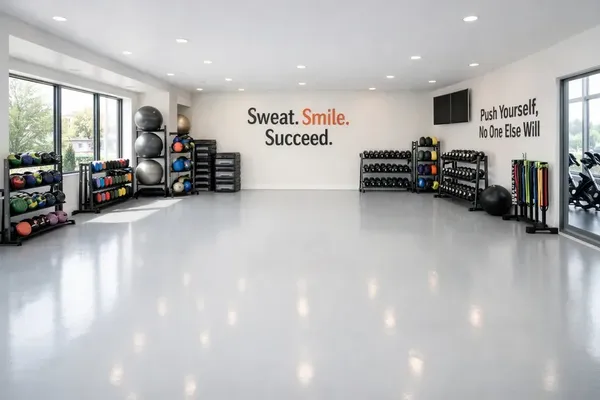
- Gyms, training floors and salons
- Auto dealers, detail shops and service bays
- Offices and flex suites along I-40 and I-85
Need a heavier-duty system for a warehouse, food plant or machine shop? See our industrial epoxy flooring page. For what commercial epoxy typically costs — national ranges, labeled as such — jump to the pricing FAQ below.
What a Triad Year Throws at a Commercial Floor — and Why Epoxy Holds
Muggy summers, ice-storm brine on every winter shoe, nightly wet-mopping and nonstop foot traffic — here is how a commercial epoxy system handles each one while your doors stay open.
Zone by zone
Your Doors Stay Open
Market week, a Saturday taproom crowd or a full clinic schedule does not pause for a floor job. We coat in phases with fast-return polyaspartic topcoats — nights, weekends or one zone at a time — so the work fits around your busiest hours.
Seamless
Built for the Health Inspection
A seamless, non-porous surface gives mildew nowhere to take hold through a humid Piedmont summer. No grout, no cracks — the finish a county health inspector wants to see in kitchens, clinics and food-prep rooms.
Sealed
Shrugs Off Grease, Brine & Chemicals
Fryer grease, sanitizers, brake fluid, and the road brine and rock salt that ride in on winter tires all sit on top of the coating instead of soaking in. That is the difference between a floor you wipe and a bare slab that scales and stains — a real edge for kitchens, service bays and retail entries in January.
Safe
Traction When the Weather Turns
A summer downpour or an ice-storm morning means wet shoes at every entrance. Broadcast anti-slip aggregate and textured topcoats keep traction high at doorways, kitchens and wash areas — helping cut slip-and-fall risk.
Written
Built for Humid Summers and Brine Winters
With moisture-tested prep underneath, a multi-layer commercial system outlasts VCT, floor paint and bare sealed concrete through the muggy season and the brine season alike, and it is backed by a written warranty you can read before you sign.
How humidity affects durability →5 min
Wipe-Clean, Skip the Wax
No stripping, no buffing, no specialty products. A dust mop and a neutral cleaner are all it takes, and the sealed surface does not hold the salt residue, mildew or red clay tracked in from job sites and ball fields that porous floors trap — saving your staff time and cutting your upkeep bill.
See commercial price ranges →Our Triad Installation Process
Humid summers and brine winters demand more prep than a dry-climate floor; here is the five-step path — built around moisture testing and your hours — that gets a Triad business a floor that lasts.
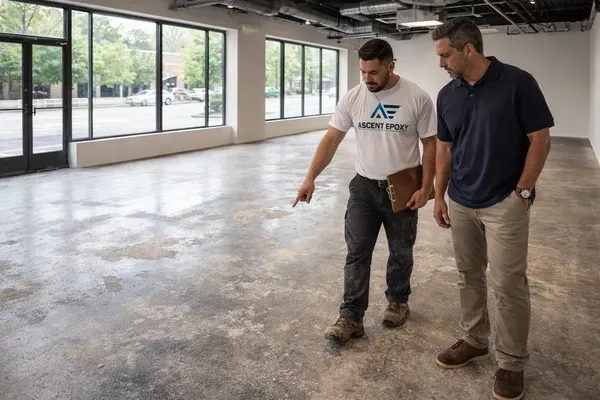
Consultation & Site Assessment
~45 minWe come to your space to check the slab for moisture and damage, measure the area, map your traffic and wet zones, and learn your busiest hours — and your Market or opening deadline — so the work fits around them, not the other way around. Schedule yours free.
Custom System Design
1–2 daysWe match the system to your space — urethane mortar for a hot, wet kitchen or brewhouse; a decorative flake or quartz finish for a showroom or lobby; moisture-mitigation primer, color, anti-slip texture and topcoat dialed in for a humid Piedmont slab. For larger floors we map out a phased, after-hours plan so you stay open.
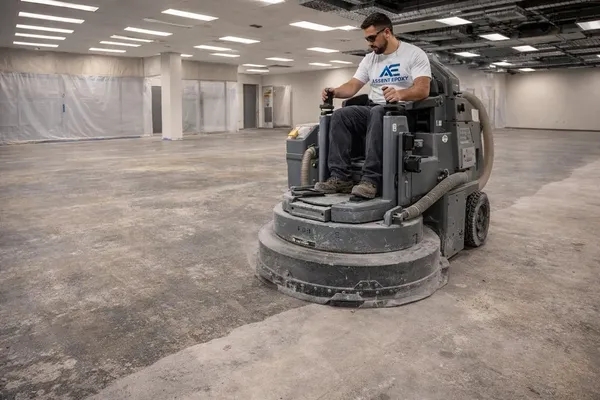
Surface Preparation
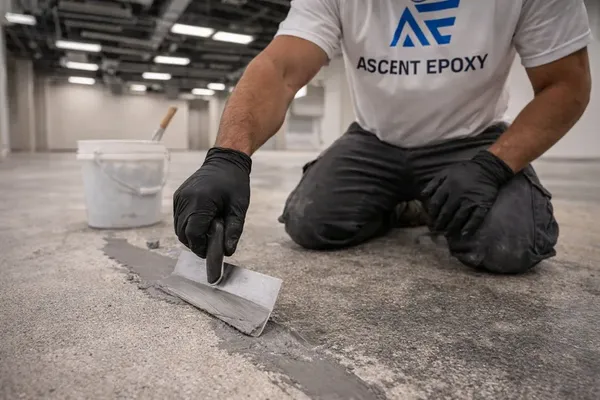
Part of a 2–5 day jobWe diamond-grind and profile the concrete to give the coating a mechanical grip. Every slab gets an ASTM moisture test first — non-negotiable on the older slabs under many Triad commercial buildings — and we add a moisture-mitigation primer wherever the readings run high.
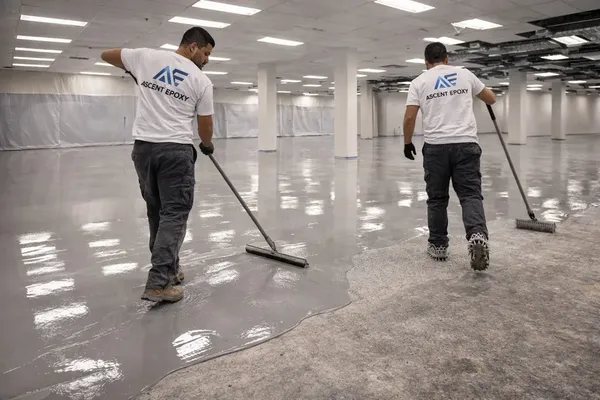
Multi-Layer Application
Part of a 2–5 day jobBlake's crew lays down primer, body coat, broadcast media (flake, quartz or metallic), and a UV-stable topcoat that handles Piedmont sun and humidity. On phased jobs we coat one zone at a time so your team keeps working in the uncoated areas.
Final Walkthrough & Handoff
~1 hrWe walk the finished floor with you, verify adhesion and finish quality, and hand over a care guide written for your space — including how to deal with the brine and salt tracked in over a Triad winter. Every install is backed by a written warranty you can read before you sign.
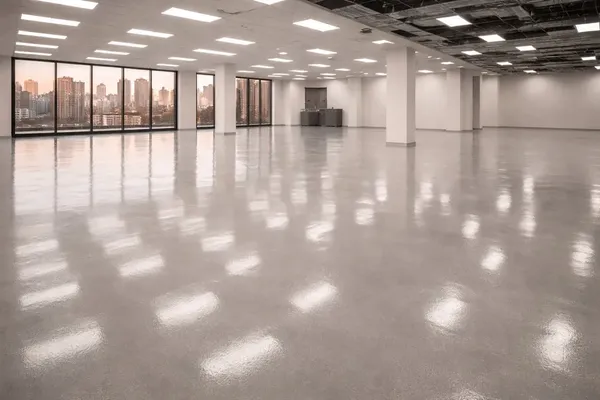
Step 1 Is a Free Site Assessment.
Schedule your no-obligation consultation and see finish samples in your space.
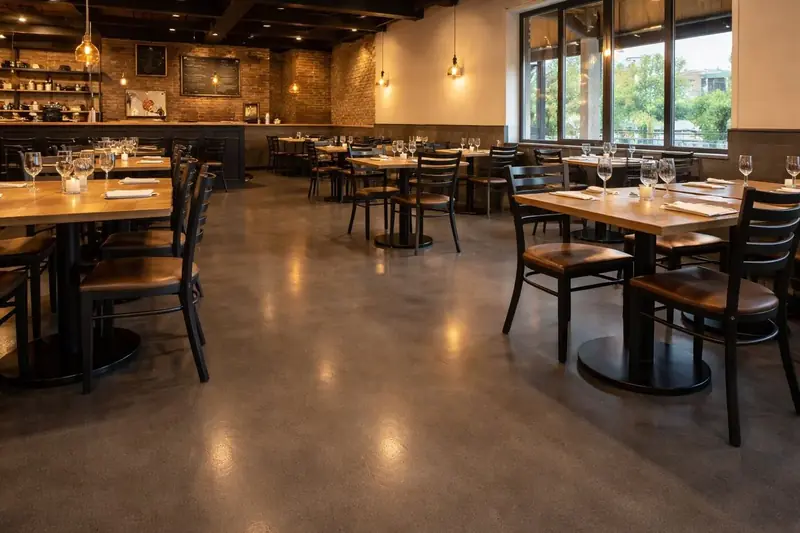
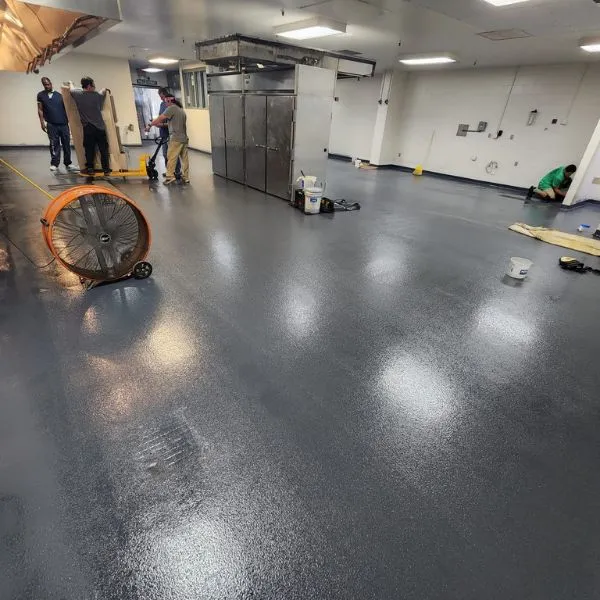
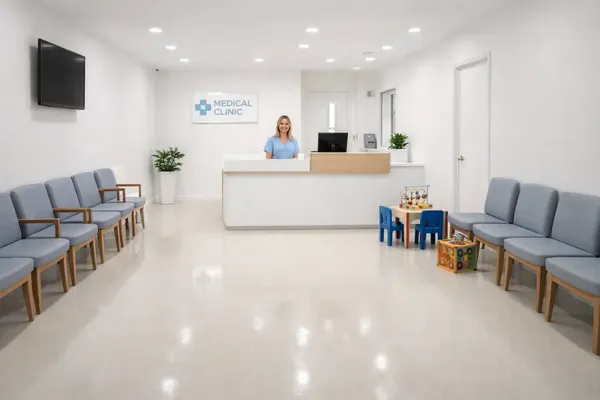
Commercial Floors by Blake's Crew
Real finished floors from the crew's other markets — a restaurant, a clinic waiting room and a fitness studio — and the same process we bring to the Triad.
Specialty Systems for Demanding Triad Spaces
Kitchens and brewhouses face heat, water and inspectors all at once, and standard epoxy is not enough there. Food plants with daily washdowns need an industrial system.
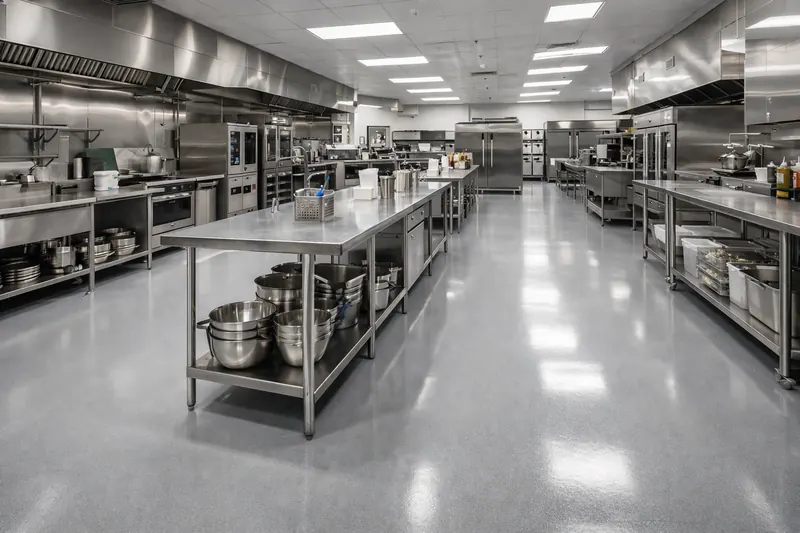
Commercial Kitchen Flooring
A working kitchen is the harshest room in any restaurant. Boiling water and fryer oil hit the floor at one temperature while a walk-in or cold line sits at another, so the slab takes constant thermal shock. Add round-the-clock moisture, caustic degreasers, and a health inspector who wants to see a seamless, crack-free surface, and ordinary epoxy simply fails.
For that environment we install urethane-mortar (urethane-cement) and high-build epoxy systems engineered for kitchens and brewhouses — the same class of floor used in commercial kitchens, taprooms and catering operations anywhere. Each one comes with broadcast anti-slip texture for wet floors, an integral cove base that seals the wall-to-floor joint against mop water and pests, and a sloped finish that drains toward your floor sinks. That is what keeps the line moving, and it is the seamless, washable surface a county health inspector looks for, even in a humid Piedmont summer. As a national benchmark, urethane mortar runs about $8–$15 per square foot installed.
Food Plants and Washdown Rooms
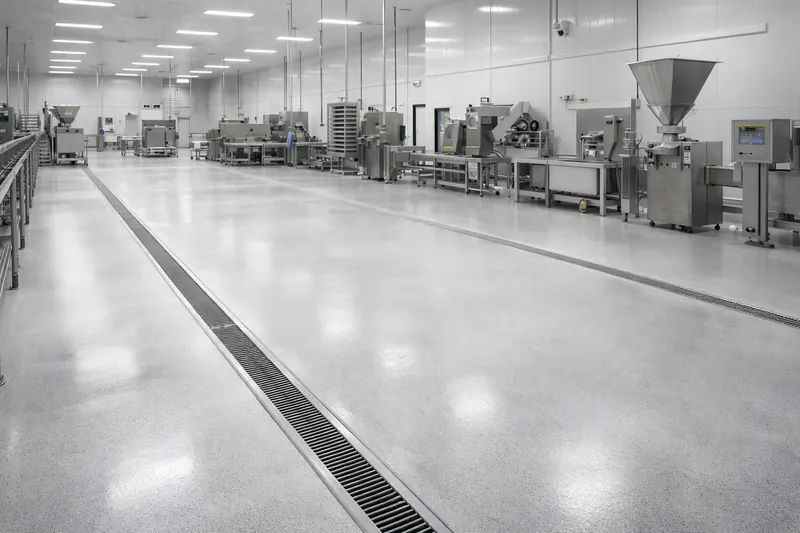
Packing houses, bottling lines, bakeries and commissaries wash their floors down daily, and that is industrial duty: urethane cement for hot washdowns, chemical-resistant resins and installs phased around production. Those systems, with national price benchmarks, are on our industrial epoxy flooring page.
Newly Serving the Triad, With the Process in Writing
Blake's crew leads every job and has done this work in ten other markets before Greensboro.

Meet Blake
Blake leads the crew from the first slab test to the final walkthrough. Commercial floors typically run two to five days on site, phased around your hours, and you get the schedule for each zone in writing before we start.
Commercial Epoxy Flooring FAQs for the Triad
Common questions from Triad business owners about commercial epoxy floor installation.
We have not found published Triad prices for commercial floors, so we quote against national ranges: roughly $3–$5 per square foot installed for a standard two-coat epoxy, $5–$8 for a high-build 100%-solids system, $5–$12 for polyaspartic, and $8–$15 for urethane mortar in kitchens and breweries. Prep is the swing factor — a slab that needs heavy grinding, crack repair or a moisture-mitigation primer costs more per foot than a clean one, and a large open floor costs less per foot than a small, cut-up one. Every quote is written and itemized after a free on-site walkthrough; our garage cost guide shows how grinding, crack repair and moisture prep move a per-foot price.
Yes. Most commercial floors go in in phases — one zone at a time, after hours, or over a weekend — so a showroom, taproom or clinic keeps operating while we work. Polyaspartic topcoats return a floor to foot traffic quickly, which is what makes an overnight or weekend turnaround realistic. Most small and mid-size commercial floors take two to five days on site, and you get the schedule, plus walk-on and roll-on times for each zone, in writing before we start.
Yes, if you book early. High Point Market runs twice a year, in April and October, so the deadline is fixed and we schedule backward from your set-up date. Individual showrooms often run 16,000 to 20,000 square feet, which makes a full-floor refresh a multi-day, phased job rather than an overnight one — lock in a date several weeks ahead of Market week, and we will confirm the phasing and return-to-service times in writing so your product moves in on time.
Yes. A seamless, non-porous epoxy or urethane-mortar floor has no grout lines for bacteria or standing mop water to sit in, which is exactly what a county health inspector wants to see in a kitchen or food-prep area. For working kitchens and brewhouses we spec urethane mortar, which takes hot water, caustic cleaners and thermal shock from a steam line next to a walk-in without cracking, and we add an integral cove base at the walls. Antimicrobial additives are available for food-prep rooms that need an extra layer of protection.
Yes. The Triad sits where I-40 and I-85 meet, and the flex, warehouse and light-industrial suites along both — from the Piedmont Triad International Airport (PTI) side of Greensboro out to Kernersville, and east through McLeansville toward Burlington — are exactly the buildings this service is built for. Forklift-rated, washdown and food-plant floors move to our industrial epoxy systems. We serve Greensboro, High Point, Winston-Salem, Kernersville, Burlington, Thomasville, Summerfield, Oak Ridge, Jamestown and Gibsonville; see our service areas page for the full list.
Showrooms and retail, taprooms and breweries, restaurant kitchens, veterinary and medical suites, gyms and training floors, auto dealers and service bays, salons, and offices — any space with foot traffic, carts, spills and a cleaning crew every night. Heavier duty — forklifts, chemical washdown, cold storage — belongs with our industrial systems, and a floor where you want the bare slab itself as the finish is a job for polished concrete. Every project starts with a free on-site walkthrough and a moisture reading, and the full ASTM slab-moisture test is run before any coating goes down.