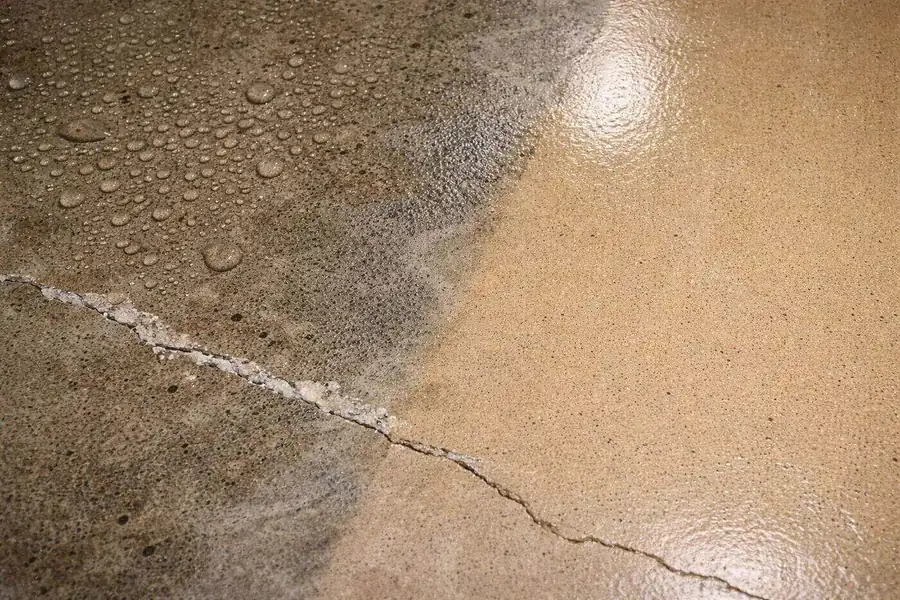
Epoxy, polyaspartic and polyurea are three different resin chemistries, and the honest answer for a Triad garage is that most professional floors use two of them: an epoxy or polyurea base coat for build and adhesion, and a polyaspartic topcoat for UV stability, chemical resistance and fast cure. The right combination depends on your slab's condition, the season you install in, and what you park on it.
If you're comparing quotes, the brand names matter less than the system behind them. Below we set the three chemistries side by side on cure time, UV stability, brine and hot-tire resistance and how each behaves in a humid Piedmont summer, then explain what the "20 times stronger" line you'll see in some ads actually measures. To see how each finish looks on your size of garage, with a typical price range attached, open the Floor Studio visualizer; for the full install process, see our garage floor coating page.
The Triad context matters. Most homes here sit on crawlspaces, so the garage is usually the only large concrete slab on the property, and with median build years of 1984 to 1990 across Greensboro, Winston-Salem and High Point, that slab is typically 35 to 40 years old. It sees muggy summers on one end of the year and ice-storm brine tracked in on tires on the other. Whatever you coat it with has to handle both.
The three chemistries in plain terms
Epoxy
Epoxy is a two-part resin that cures through a reaction between the resin and a hardener. A 100 percent solids epoxy builds real thickness in one coat, bonds hard to properly ground concrete and fills minor surface texture, which is why it makes an excellent base coat. Its weaknesses are on the surface. Most epoxies amber under UV light, so a floor near an open garage door yellows over time, and they cure slowly: expect roughly 12 to 24 hours between coats and several days before you park on it. Epoxy is also touchy during cure. Warm, humid air over a cool slab can leave a cloudy blush on the surface, and a thin water-based epoxy, which is what most big-box kits are, softens under a hot tire and peels.
Polyaspartic
Polyaspartic is a type of aliphatic polyurea, and it's the topcoat most professional garage systems use today. It's UV-stable, so it won't yellow. It cures fast, with walk-on within hours and vehicles typically the next day or two, which is how a two-car garage gets finished in one day on site. It resists hot-tire pickup, oil, gasoline and de-icing chlorides better than epoxy does, and it cures across a wider temperature range, including cool weather that would stall an epoxy. The trade-offs: it goes on thinner, so it needs a solid base coat under it; it costs more per gallon; and its short working time makes it a professional's material. It also reacts with moisture, so a damp slab or a dew point too close to slab temperature can cause bubbling. That's why timing matters in a Triad summer.
Polyurea
Pure polyurea, the fast-set version used in spray-on truck-bed liners, sets in seconds to minutes and is extremely flexible. In garage systems it usually appears as a slower-reacting hybrid base coat, where that flexibility helps bridge hairline cracks and ride out temperature swings in the slab. Most base-coat polyureas are aromatic, which means they yellow under UV, so they're finished with a polyaspartic topcoat. Because the working time is short and the material is unforgiving, polyurea systems are almost always installed by trained crews, and they're the chemistry behind most franchise garage-floor brands.
Polyaspartic garage floor vs epoxy and polyurea: cure, UV, hot tires and brine
| Property | Epoxy | Polyaspartic | Polyurea (hybrid base) |
|---|---|---|---|
| Typical role | Base or build coat | Topcoat | Base coat |
| Walk-on / drive-on | Overnight / several days | Hours / a day or two | Hours / a day or two, with topcoat |
| UV stability | Ambers over time | Stable, no yellowing | Yellows unless topcoated |
| Hot-tire resistance | Good if 100% solids; poor if water-based | Very good | Good; the topcoat does the work |
| Brine and chemical resistance | Good | Very good | Good; the topcoat does the work |
| Flexibility | Rigid | Moderate | High |
| Humidity sensitivity at install | Blushes in humid air | Bubbles if the slab is damp or near dew point | Moisture-sensitive; fast set limits exposure |
| Install temperature window | Slab in the 50s or warmer for most products | Wide, including cool weather | Wide |
| Material cost | Lowest | Highest | Middle to high |
Read across the rows and a pattern shows up: the failure modes that matter in a garage (yellowing, hot-tire pickup and chemical attack) all live at the surface, and polyaspartic wins every one of them. The properties that matter at the slab (adhesion and build) belong to the base coat, where epoxy and polyurea each have a case. That's why the systems worth buying are hybrids.
What "20 times stronger than epoxy" actually measures
You'll see this multiplier in ads for polyurea garage systems. It comes from a single laboratory property, usually tensile strength or elongation measured on a free film of cured material, sometimes an abrasion-loss test. On that one property a flexible polyurea can outscore a rigid epoxy by a wide margin. The number is real; the conclusion people draw from it isn't.
Garage floors don't fail because the coating film tears in tension. They fail at the bond line, when a coating goes over dirty, unground or damp concrete and lifts, or at the surface, when a thin or non-UV-stable material yellows, chalks or softens under hot tires. Neither failure is predicted by tensile strength. A polyurea film can be many times stronger than an epoxy film on paper and still peel in a season if the slab wasn't ground and moisture-tested first. Meanwhile a properly prepped 100 percent solids epoxy base with a polyaspartic topcoat has been holding up on garage floors for years.
Polyurea's flexibility is a genuine advantage on a slab that moves or carries hairline cracking, and we'd never tell you otherwise. But "stronger" isn't a spec you can hold anyone to. Ask any installer, us included, for three things instead: the product data sheets for the base and the topcoat, the prep method in writing, and the warranty as a document rather than a word.
See flake, solid, metallic and quartz on your size of garage.
Pick a project, a finish and a color. Floor Studio shows a sample render and a typical Triad price range in about a minute, before you talk to anyone.
Cure time and humid-summer install timing in the Triad
Greensboro's muggy season runs from about May 24 to September 28, and July is the worst of it, with average humidity near 70 percent and roughly 33 days a year at or above 90 degrees. The rule for any resin coating is that the slab surface has to stay above the dew point while it cures; the usual rule of thumb is at least 5 degrees. When it doesn't, moisture condenses on or in the fresh coating: an epoxy blushes cloudy, and a polyaspartic can foam or bubble.
That's why summer installs in the Triad start early. A slab that's been shaded overnight is cooler than the afternoon air, so the crew checks slab temperature and dew point before opening a kit, grinds early, and gets the base coat down before the afternoon humidity peaks. Polyaspartic's fast cure is an advantage here, because it's through the vulnerable window in hours rather than overnight. It also punishes mistakes, since there's no time to fix a bad pour. If an installer books a mid-afternoon July start without asking about the slab, that's a warning sign.
Winter is the opposite problem. Greensboro normally has about 68 nights a year at or below freezing, and January averages a low around 32 degrees and a high near 49. Most epoxies want the slab in the 50s or warmer to cure properly, which can stall a January install. Polyaspartics cure at lower temperatures, which is why the install season doesn't have to stop for winter.
Brine, road salt and hot tires
Triad winters are mild, with a normal snowfall of 7.1 inches, so don't let anyone sell you a story written for a snowier state. What the Piedmont does get is freezing rain and ice. Cold air trapped against the east side of the Appalachians while warm, wet air rides over it is the pattern behind the region's ice storms, and one North Carolina weather writer has called Greensboro the freezing-rain capital of the Southeast. When a storm is coming, NCDOT pre-treats highways with a 23 percent salt brine and follows with rock salt and sand, and the City of Greensboro brines its priority routes, including Wendover Avenue, Battleground Avenue and Gate City Boulevard.
All of that ends up on your tires and then on your garage floor. On bare concrete, chloride de-icers plus freeze-and-thaw cycles cause scaling, where the surface flakes away in thin layers. A coated floor doesn't scale, because the chlorides never reach the cement paste, and a polyaspartic topcoat resists chlorides better than epoxy alone. The one caveat: coat the slab before it scales. Once scaling starts, the loose surface has to be ground off and patched before any system goes down, which is where a repair and resurfacing job begins.

Summer brings the other classic failure, hot-tire pickup. With 33 days a year at 90 degrees or above, a tire coming off the highway can be hot enough to soften a thin epoxy, and when it cools it lifts the coating off in tire-shaped patches. A 100 percent solids base with a polyaspartic topcoat is the fix. A one-coat kit from a big-box store is the cause.
What each system costs
Per square foot installed, typical 2026 Triad ranges run about $4 to $6 for solid-color epoxy and about $4.50 to $8 for flake with a polyaspartic topcoat, which puts most two-car garages between $2,000 and $4,000. Metallic and quartz systems run about $8 to $12 or more. Franchise polyurea systems rarely publish prices; national aggregator ranges put polyurea-based garage floors at roughly $5 to $10 per square foot installed, so budget them in the upper half of the flake range or above. These are typical ranges drawn from published local and national cost guides, not a quote. The full breakdown, including what a 1980s slab adds in grinding and repair, is in our 2026 Greensboro garage floor cost guide.
What we install on a Triad garage, and why
For most Triad garages we install a hybrid system: ASTM slab-moisture test, diamond grind, crack and spall repair, an epoxy or polyurea base coat, a full flake broadcast, and a UV-stable polyaspartic topcoat. The base does the bonding and the build. The polyaspartic handles UV, brine, hot tires and the fast cure: walk-on within hours and vehicles typically the next day or two. Most two-car garages are one day on site, summer installs start in the morning, and you get the walk-on and drive-on times for your exact system in writing before we begin.
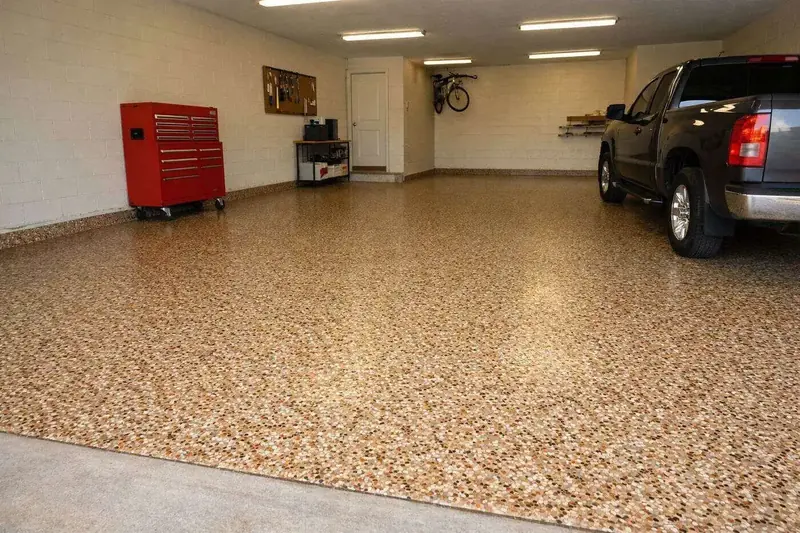
We're newly serving the Triad, so we'd rather show you the process than ask you to take our word for it. Blake leads the crew that will be on your floor, the warranty is a written 25-year document covering delamination, peeling, cracking and adhesion, and you can read it before you sign. In Winston-Salem, which has noticeably more basements than Greensboro or High Point, the same moisture-first logic applies below grade, and we test that slab too.
Not sure which system your slab needs?
Book a free estimate. We'll take a moisture reading on the slab, look at the cracks and the scaling, and put the system and the warranty in writing.
Frequently asked questions
Is polyaspartic better than epoxy for a garage floor?
As a topcoat, yes. Polyaspartic is UV-stable, cures in hours and resists hot tires and de-icing chlorides better than epoxy does. As a base coat, a 100 percent solids epoxy still does an excellent job of bonding to ground concrete and building thickness, which is why most professional systems put an epoxy or polyurea base under a polyaspartic top rather than relying on one chemistry alone.
Is polyurea really 20 times stronger than epoxy?
On one laboratory property, usually tensile strength or elongation of a cured film, a flexible polyurea can outscore a rigid epoxy by a wide margin, so the number is not invented. It just does not predict how a garage floor performs. Floors fail at the bond with the concrete and at the surface under UV and hot tires, and those depend on prep, moisture testing and the topcoat, not on film tensile strength.
Can you install a garage floor coating during a humid Triad summer?
Yes, with the right timing. The slab has to stay several degrees above the dew point while the coating cures, so summer installs start early in the morning, the crew checks slab temperature and dew point before opening any material, and the fast-curing polyaspartic topcoat gets through its vulnerable window before afternoon humidity peaks.
Will road brine and salt damage a coated garage floor?
No. Scaling from de-icing chlorides happens on bare concrete, where salt and freeze-and-thaw cycles break down the surface. A coated floor keeps the chlorides off the cement paste, and a polyaspartic topcoat resists them better than epoxy alone. Rinse the slush off when you can, and coat the floor before scaling starts rather than after.
How soon can I park on a new garage floor?
With the polyaspartic topcoat we install, walk-on is usually within hours and vehicles typically the next day or two, depending on the system and the weather; epoxy-only systems need several days. You get the exact walk-on and drive-on times for your system in writing before we start.
Choosing a chemistry is really choosing a process
Epoxy, polyaspartic and polyurea all work when they go down over ground, tested concrete at the right slab temperature, and all fail when they don't. Try the Floor Studio to see the finishes and a typical range for your garage, then request a free estimate online or call (336) 358-6309. Estimates are free, Monday through Saturday, across Greensboro, High Point, Winston-Salem, Kernersville and the rest of the Triad.
Written by the Ascent Epoxy Greensboro team. Blake, pictured, leads the install crew. Coating behavior described here is standard industry practice; local climate figures come from National Weather Service normals and published NCDOT and City of Greensboro winter-operations guidance.