A flake garage floor finished with a polyaspartic topcoat typically runs about $4.50 to $8 per square foot installed in the Triad in 2026, which puts most two-car garages between roughly $2,000 and $4,000. Solid-color epoxy sits a little lower, metallic and quartz systems sit higher, and the condition of a 35-to-40-year-old slab is what moves your number inside those ranges.
Those are typical ranges, not a quote. We built them from the overlap of published sources: a local 2026 Greensboro price guide, Thumbtack's Greensboro average garage installation figure ($1,870 to $2,700), Bob Vila's polyaspartic floor coating cost guide ($4 to $9 per square foot, updated January 2024) and national epoxy cost guides. No installer can give you a firm number without standing on your slab. If you want a range for your own garage before you talk to anyone, the Floor Studio visualizer lets you pick a size, finish and color and shows a typical range in about a minute. For what the full system involves, start with our garage floor coating page.
This guide is written for the Triad homeowner whose house went up in the late 1980s on a crawlspace. On that house the garage is usually the one big slab-on-grade surface, and after decades of hot tires, oil drips and tracked-in winter brine it's stained, pitted and sometimes flaking at the surface. That slab, more than the finish you pick, is the whole cost story.
Typical 2026 epoxy garage floor costs by finish
"Epoxy" is shorthand for a family of coating systems, and the system you choose is the first lever on price. The per-square-foot figures below are installed ranges that include standard prep. The two-car totals are simply those ranges multiplied by a 400-to-500-square-foot garage and rounded, so treat them as arithmetic, not a promise.
| Finish | Typical installed range | Two-car garage (400–500 sq ft) |
|---|---|---|
| Solid-color epoxy | about $4–$6 per sq ft | about $1,600–$3,000 |
| Flake with polyaspartic topcoat | about $4.50–$8 per sq ft | about $2,000–$4,000 |
| Metallic epoxy | about $8–$12+ per sq ft | about $3,200–$6,000+ |
| Quartz broadcast | about $8–$12+ per sq ft | about $3,200–$6,000+ |
Solid color is the utility choice: one uniform color, easy to sweep, no decorative premium. Flake is what goes on most garages because the chips hide tire marks and dust and add grip, and the polyaspartic topcoat over the flake is what gives the floor its UV stability and chemical resistance. Metallic and quartz are labor-heavy decorative or heavy-duty systems, and their totals climb with the complexity of the design or the thickness of the broadcast.
Common add-ons
| Line item | Typical add |
|---|---|
| Crack and spall repair | +$100 to $500+ per garage; more on a badly spalled slab |
| Moisture-mitigation primer (only if the ASTM test calls for it) | about +$1 per sq ft |
| Extra grinding to remove an old sealer, paint or a failed DIY kit | priced on the estimate visit |
| Cove base up the stem wall, steps and landings | priced per linear foot on the estimate |
What a two-car garage actually lands at
A typical two-car garage is about 400 to 500 square feet. With flake and a polyaspartic topcoat at $4.50 to $8 per foot, that's the $2,000 to $4,000 band most Triad homeowners land in. A slab in good shape with a standard flake blend sits near the bottom of it. A slab that needs crack repair, heavy grinding or a moisture primer, or a premium blend under a thicker topcoat, moves toward the top. Solid-color epoxy on the same garage runs roughly $1,600 to $3,000. Choose a metallic or quartz system and the same bay starts around $3,200 and can pass $6,000 depending on the design.
See a typical range for your own garage in about a minute.
Pick your garage size, a finish and a color. Floor Studio shows a sample render and a typical Triad price range before you ever pick up the phone.
Two things move the total more than the finish: how much prep your slab needs, and whether the concrete is holding moisture. On a garage poured in the 1980s both come up more often than a national calculator assumes, so they get their own section.
What drives the price on a 1980s Triad slab
Slab age
The median home in Greensboro was built in 1987, in Winston-Salem in 1984 and in High Point in 1990, according to the latest Census estimates, which makes the typical garage slab 35 to 40 years old. Concrete that age has absorbed decades of oil, tire rubber and de-icing salt, and it usually shows some pitting, hairline cracking and surface wear. None of that rules out a coating. It just means more prep hours, and prep is where the price moves.
Diamond grinding
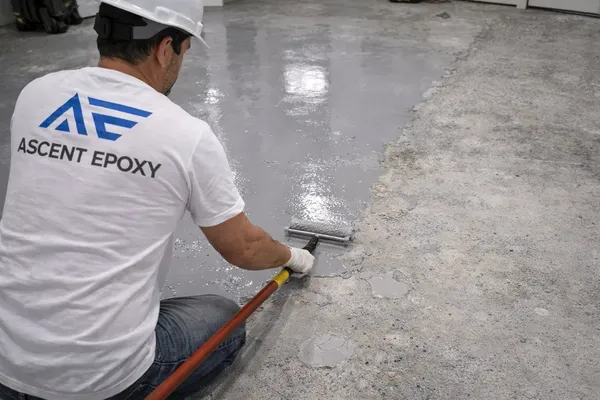
Every floor we coat is diamond-ground, not acid-etched. Grinding opens the concrete so the base coat can bond, strips old sealers and paint, and levels light spalling, and it's included in the per-foot range. What adds time is a slab with a previous coating on it, especially a failed big-box kit that has to come off completely before anything new goes down.
Crack and spall repair
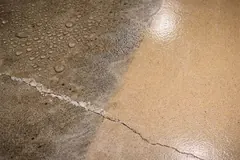
Hairline cracks and control joints are filled with a crack-repair compound and ground flush, and pitted or spalled areas are patched the same way. Typical repair adds $100 to $500 to a two-car garage. A slab that has scaled badly over a large area may need a full skim coat before coating, and that's quoted separately after we see it. If your floor is already flaking, our repair and resurfacing page covers what that work involves.
Moisture testing and mitigation
We take a free moisture reading at the estimate visit and run the full ASTM slab-moisture test (F1869 or F2170) before any coating goes down. A moisture-mitigation primer, at roughly a dollar more per square foot, is priced on your written quote up front and goes down first if the test calls for it. A coating is not a vapor or radon barrier and we won't sell it as one; the primer is there so the coating stays bonded. A 1987 pour may have gone in without a vapor retarder, and you can't see that from the surface, so every slab gets the test instead of a guess.
Winter brine and scaling
NCDOT treats Triad highways with a 23 percent salt brine 24 to 48 hours ahead of a storm and spreads rock salt and sand after plowing, and the City of Greensboro pre-treats its priority routes, including Wendover Avenue, Battleground Avenue and Gate City Boulevard. Your tires carry that slush into the garage, where chlorides plus freeze-and-thaw cycles cause the surface flaking that concrete engineers call scaling. Winters here are mild, with a normal snowfall of 7.1 inches, but a scaled surface still means extra grinding and sometimes a skim coat before the coating goes down. The polyaspartic topcoat is what protects the finished floor from the road brine and rock salt that ride in on tires after the next ice storm.
Summer timing
Greensboro's muggy season runs from late May to late September, and July averages around 70 percent humidity with roughly 33 days a year at 90 degrees or above. Humidity doesn't change the price, but it changes the schedule. A coating can't go down when the slab is close to the dew point, so summer installs start early in the morning and are timed to the slab, not the clock. If an installer promises a mid-afternoon July start without asking about the slab, ask why.
Why marketplace averages come in lower
You'll see lower numbers online. One national contractor marketplace shows an average Greensboro garage install of about $1,870 to $2,700, and national cost guides put installed epoxy at about $4 to $10 per square foot and polyaspartic at $4 to $9. The marketplace figure doesn't publish how it's built, so treat it as a floor rather than a target, and the national ranges are wide enough to be true almost anywhere. Our $4.50-to-$8 flake range sits inside both national ranges and runs higher than the marketplace average. What's different is that it assumes a diamond grind, a moisture test and a polyaspartic topcoat every time, which is what a floor needs to last on an old slab.
What every Ascent Epoxy Greensboro quote includes
We're newly serving the Triad, so we'd rather show you the process and the paperwork than ask you to take our word for it. Every garage quote covers the same six steps: ASTM slab-moisture test, diamond grind, crack and spall repair, base coat, flake or solid color, and a UV-stable polyaspartic topcoat. Most two-car garages are one day on site, and before we start you get the walk-on and drive-on times for your exact system in writing.
The warranty is a 25-year written document covering delamination, peeling, cracking and adhesion, and you can read it before you sign. Blake leads the crew that will be on your floor, and you'll know his name before the estimate visit. Estimates are free, Monday through Saturday, and every call or form gets a callback the same business day.
Want a number for your slab, not an average?
Tell us about your garage and we'll schedule a free estimate visit with the moisture meter and the warranty document in hand.
How to compare quotes line by line
A dollar-per-foot figure means nothing if it quietly leaves out the work that makes an old slab hold a coating. Before you compare estimates, check that each one spells out the same six things:
- The moisture test is named. If a quote doesn't mention testing the slab, ask.
- The prep method is in writing, and it says diamond grind, not acid etch.
- Crack and spall repair is in scope, not an add-on discovered on install day.
- The system is complete: base coat, decorative layer and a UV-stable polyaspartic topcoat. One roll-on coat is not a system.
- The warranty exists as a document you can read, with what it covers and what voids it. A "lifetime" promise with no paperwork means whatever the installer decides it means later.
- You compare the all-in total, not the per-foot headline.
When one estimate lands far below the rest, the gap is almost always missing work: no test, an acid wash instead of a grind, a thin consumer-grade resin and no real topcoat. Those omissions save money for about a year and then cost the whole floor.
Frequently asked questions
How much does it cost to epoxy a 2-car garage in Greensboro?
Most two-car garages in the Triad land between about $2,000 and $4,000 for a flake floor with a polyaspartic topcoat, which works out to roughly $4.50 to $8 per square foot installed. Solid-color epoxy runs about $4 to $6 per square foot, and metallic or quartz systems about $8 to $12 or more. These are typical 2026 ranges drawn from published cost guides, not a quote; the final number depends on your slab.
Does a crawlspace house change the price of a garage floor coating?
No. Even when the house sits on a crawlspace, the garage floor is poured concrete on grade, so it takes a coating the same way any slab does. The price is driven by the slab's condition, its size and the finish you choose, not by the foundation under the rest of the house.
Will a 1980s slab cost more to coat than a newer one?
Often a little. An older slab usually needs more grinding and some crack or spall repair, which typically adds $100 to $500 on a two-car garage, and occasionally a moisture-mitigation primer at about a dollar more per square foot if the ASTM test calls for it. A slab that has scaled badly may also need a skim coat, which is quoted after we see it.
Is a DIY epoxy kit cheaper than a professional garage floor?
Up front, yes. A big-box kit is a thin, water-based coating with no grinding, no moisture test and no UV-stable topcoat, so it tends to peel under hot tires and lift where the slab holds moisture. When it fails, the old coating has to be ground off before a proper system can go down, which adds to the cost of the eventual professional floor.
Get a typical range for your garage, then a real number
Ranges get you oriented; a real number needs someone on your slab with a moisture meter. Try the Floor Studio for a typical range in about a minute, then request a free estimate online or call (336) 358-6309 and we'll set up a visit. Estimates are free across Greensboro, High Point, Winston-Salem, Kernersville and the rest of the Triad.
Written by the Ascent Epoxy Greensboro team. Blake, pictured, leads the install crew. Prices are typical 2026 ranges drawn from published local and national cost guides; they are not a quote, and every job is priced after an on-site look at the slab.